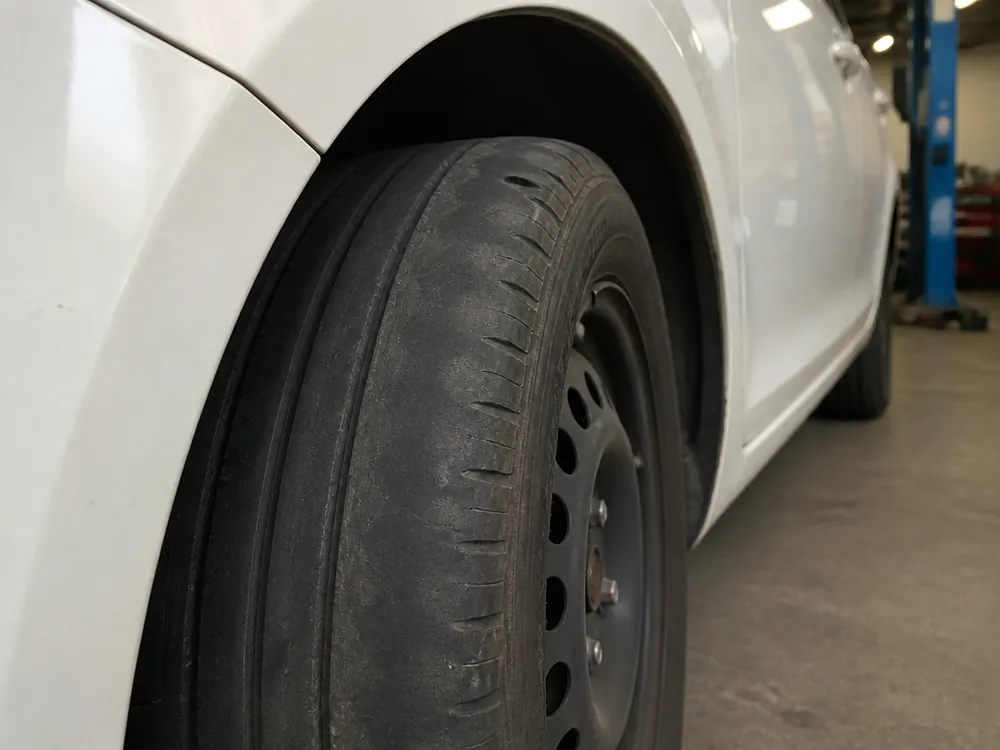
A car pulling to one side doesn't always mean the angles are off. We separate the symptoms that call for adjustment from the cases where suspension diagnostics is needed first.
When pulling isn't due to angles and suspension diagnostics is needed
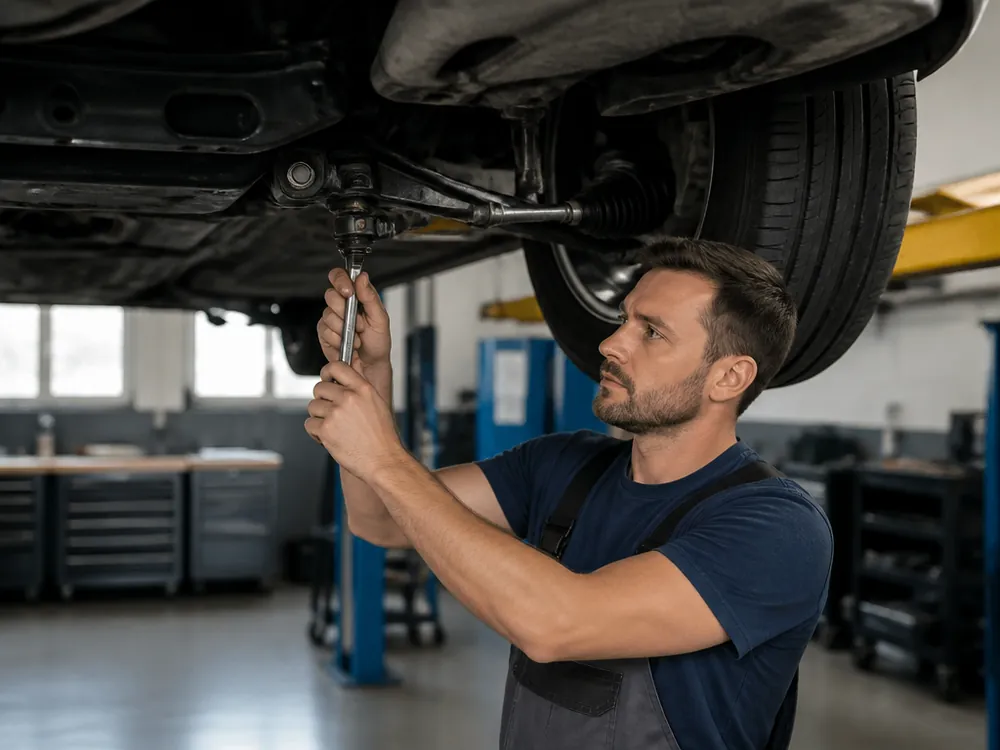
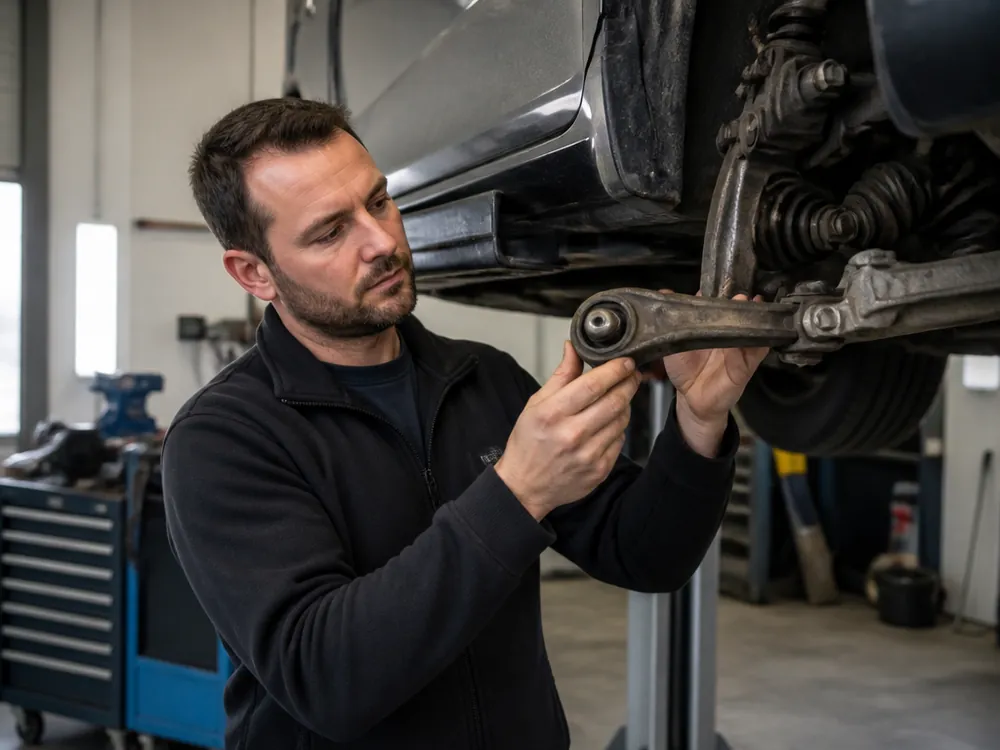
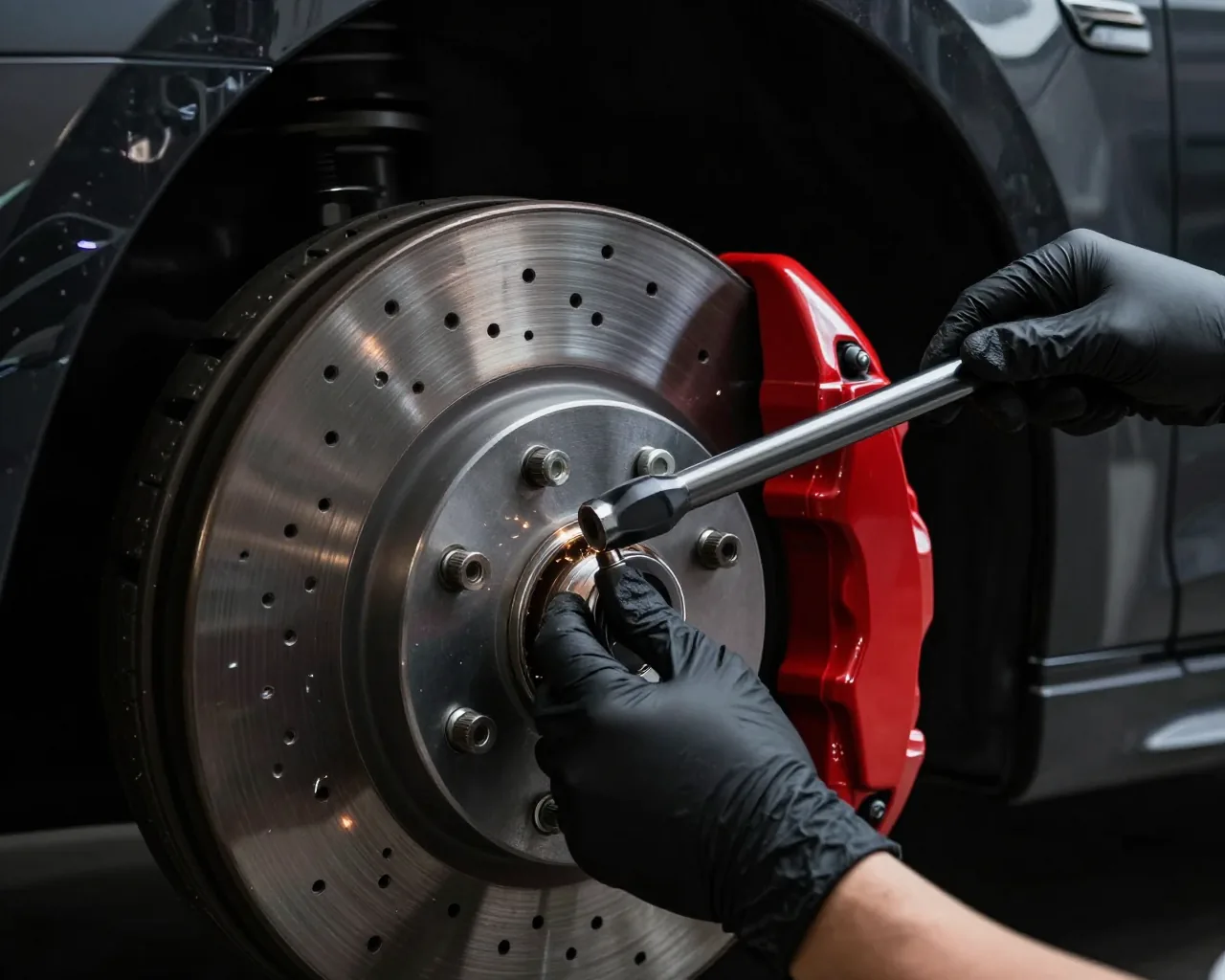
Before adjustment, our technician checks for play in ball joints, tie rods, and bushings: if a component is worn, angle adjustment won't hold the result. A worn bushing or a shot ball joint "floats" under load — the stand will show normal, but on the road the angles will drift again. So we fix the play first, then set the angles. We also check tire pressure: a difference between wheels shifts the contact patch and skews the measurement. Worn suspension is a common reason why another shop adjusted it but the car still pulls. At CARGID, the service advisor manages the work order from diagnostics to handover, and we take photos at key stages. If repair is needed, you get a written estimate first, and work starts only with the client's consent. This sequence saves a repeat visit: replacing parts blindly costs more than checking for play once.
How often to check angles and whether seasonal tire changes throw them off
There's no separate "once a season" rule: it's worth checking the parameters after an impact, suspension repair, or a change in tire size, and with calm driving — by symptoms. Switching to a different tire size or profile changes the contact patch and scrub radius — angles set for the old tires may cause pulling, so a measurement here is not superfluous. Seasonal tire changes to the stock size don't throw off geometry by themselves: wheels are removed from the same hubs. But if pulling appears after tire service, it's more often due to uneven pressure or imbalance, not angles. Almaty residents drive on city roads with potholes and speed bumps — hitting a curb in a parking lot throws off toe more often than a scheduled tire change. Wheel alignment during suspension repair is mandatory — see the separate section.
How wheel alignment on a 3D stand works and what you get in hand
We show the car's path from driving onto the measuring complex to handover: what the technician checks before measurement, how angles are set, and what verifiable result the client receives.
What camber, toe, and caster are
- Camber: the tilt of the wheel from vertical in the transverse plane — negative when the top leans inward, positive when outward.
- Toe: the angle between the wheels in plan view — they point slightly inward or outward relative to the direction of travel.
- Caster: the tilt of the steering axis in the longitudinal plane — it determines steering return to center and straight-line stability.
- Factory specs: the manufacturer sets an allowable range for each parameter separately for the front and rear wheel pairs.
- Combined adjustment: the parameters are linked — adjust one and the neighboring one shifts, so they're set in one go.
How adjustment on the stand works
- Pressure check: we measure pressure in each wheel and inflate to the manufacturer's spec — otherwise toe readings shift.
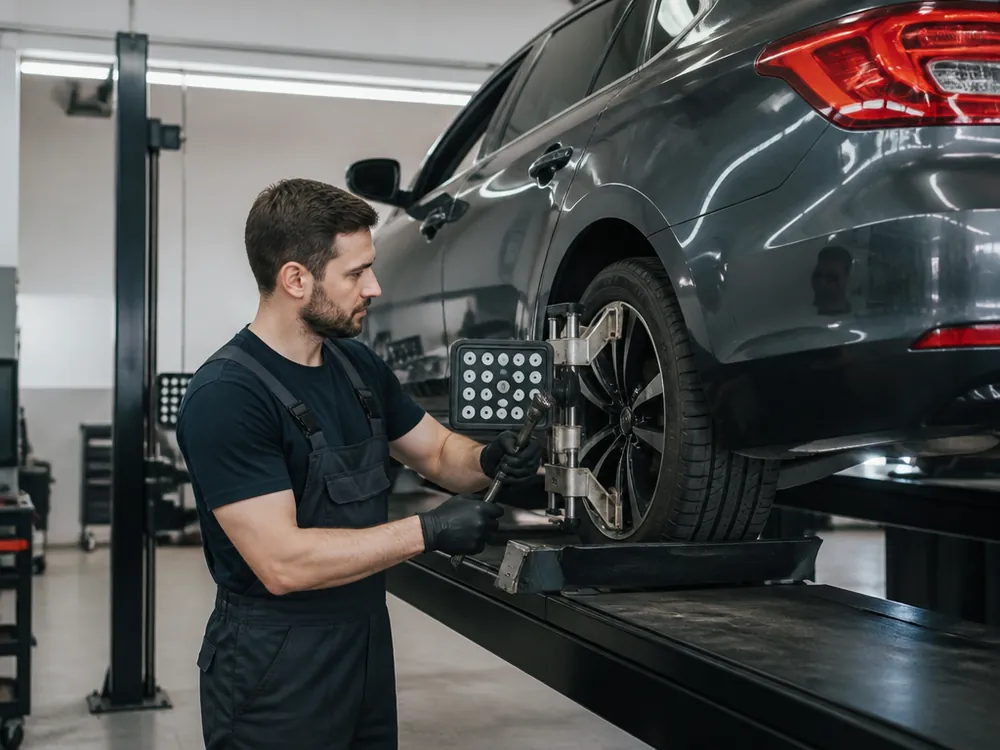
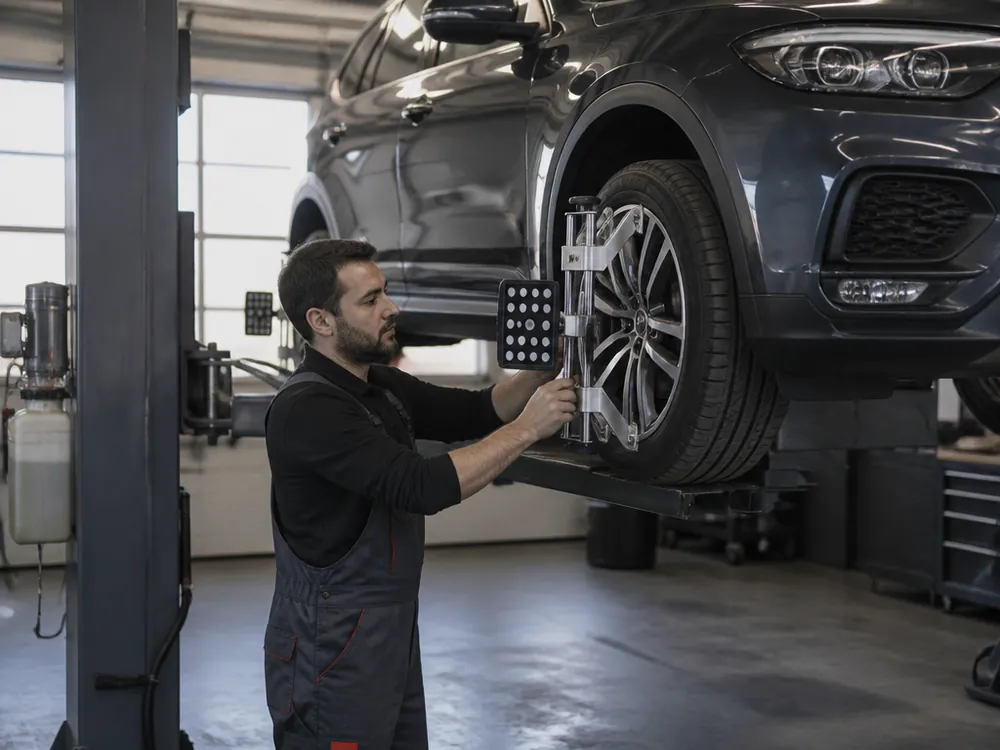
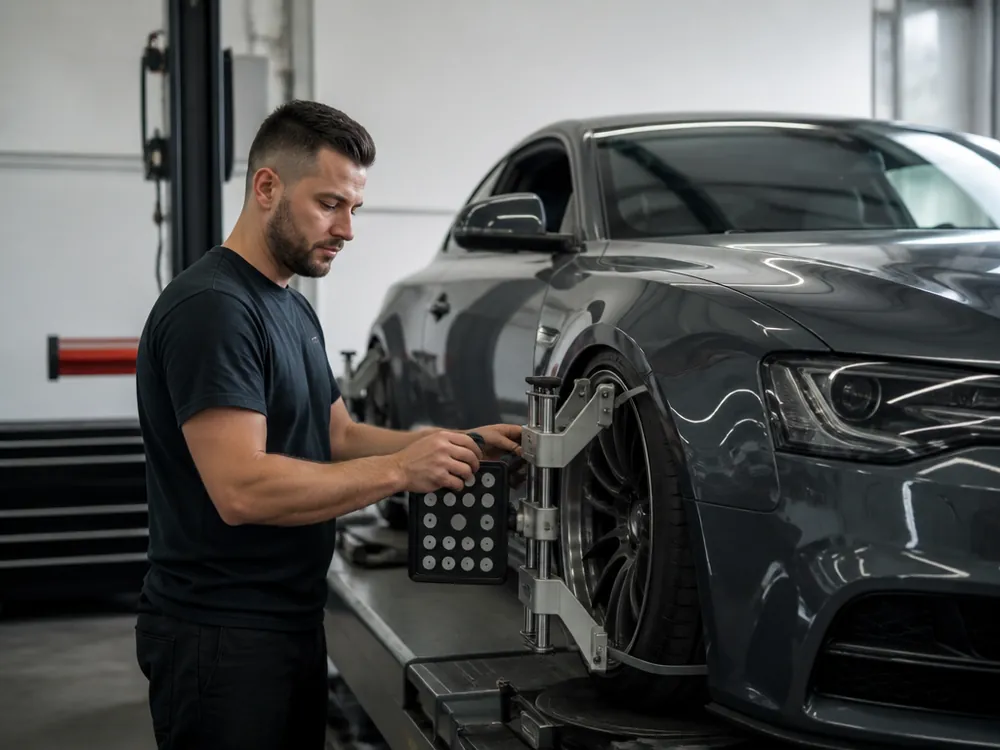
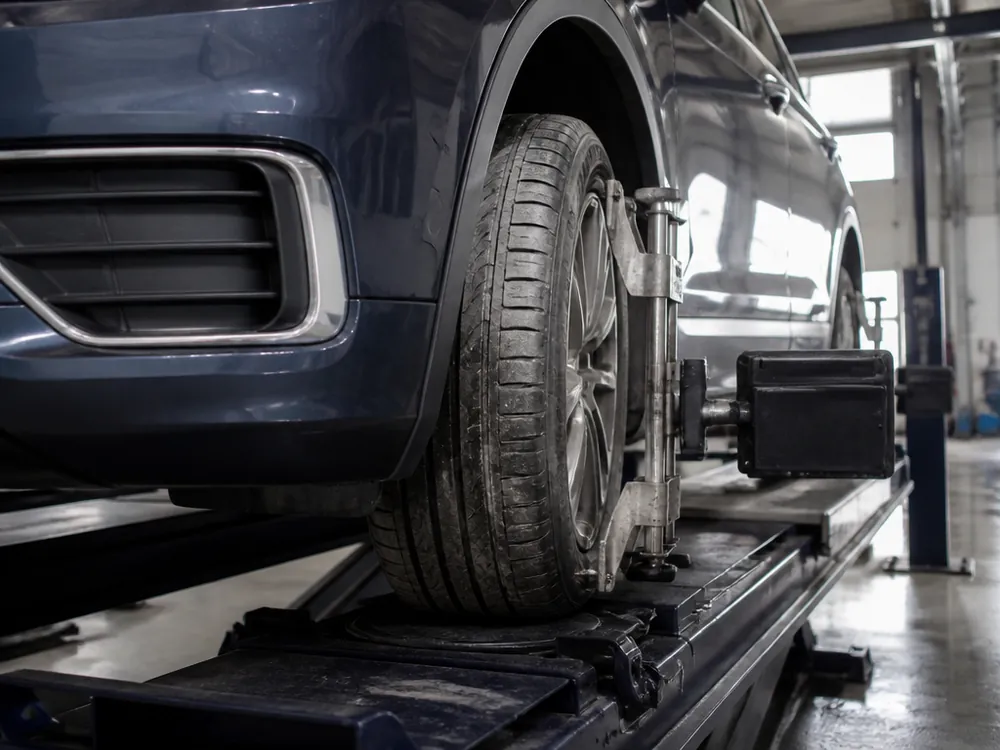
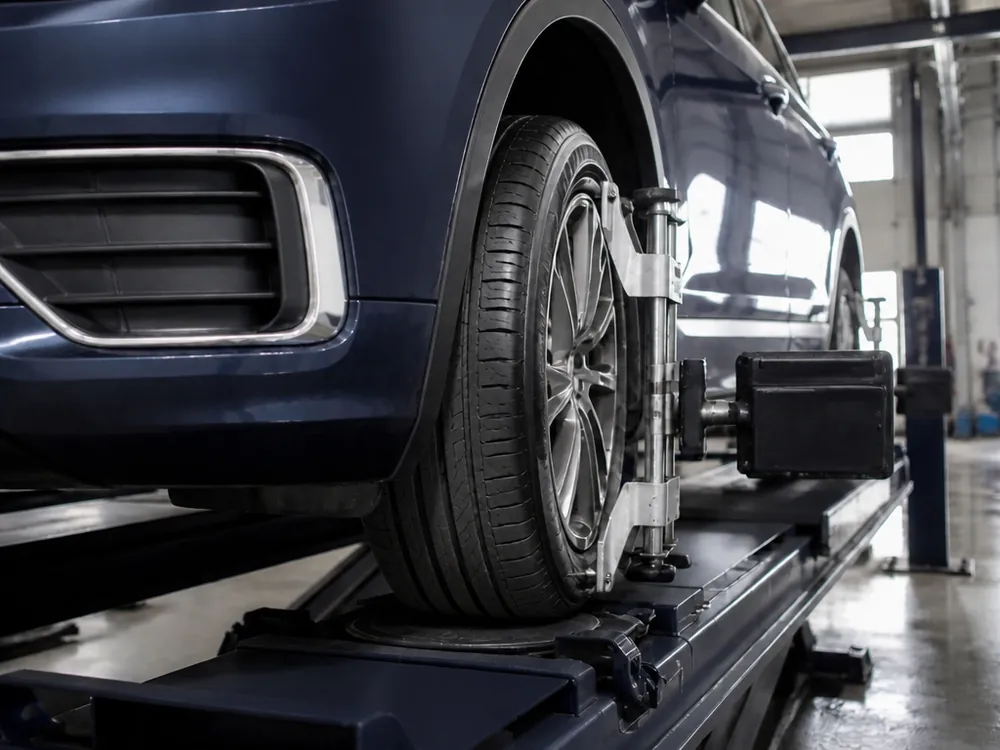
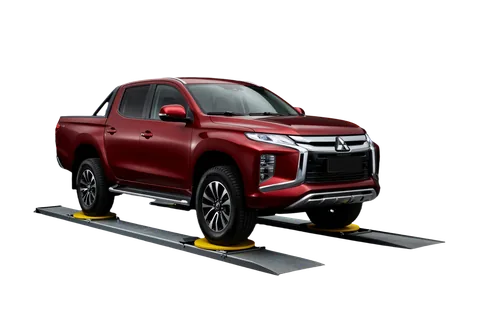
- Drive-on: the car goes onto the pads, targets are mounted on the rims, and the equipment reads wheel position in three planes.
- Angle measurement: the 3D stand records camber, toe, and caster, and the result is immediately compared with factory data.
- Adjustment: we loosen only the adjustment bolts and collars, work on the loaded axle — we don't heat or bend the arms.
- Control measurement: we repeat the procedure and make sure all parameters remain within spec after tightening.
- Test drive: the service advisor checks the car on the road — the steering wheel is straight, no pulling.
- Time: a standard two-axle adjustment takes 60 minutes — the lift and targets are prepared in advance.
What you get in hand after the work
After the work, we provide a printout of angles before and after, a work order with warranty, and perform a test drive before handing over the car. The printout shows each parameter: what it was on entry, what range it was brought into, and whether it hit the factory spec. The work order records the list of operations, replaced adjustment bolts or eccentrics if needed, and the 6-month warranty — we put it in the handover document. The test drive is performed by the service advisor who managed the work order from intake. The "before and after" printout is a verifiable document: it shows which angles were out of spec and how much they were corrected, not just "adjusted." Keep it until your next visit — on a repeat visit, the technician will immediately see the baseline and assess whether the angles were knocked off by an impact or by worn parts.
Angle adjustment by suspension type, not by brand
Instead of listing brands, we group the work by suspension design: the owner finds their case and understands in advance how many wheels are adjusted and which angles are considered during measurement.
How adjustment differs on various suspension types
which axles and angles each suspension type affects| Suspension type | What is adjusted | Measurement specifics |
|---|
| Rear beam | Front axle | Rear angles are not adjustable |
|---|
| Multi-link | All 4 wheels | More adjustment points |
|---|
| Independent 4WD | All 4 wheels | We account for drive and load |
|---|
| Lowered or lifted | All 4 wheels | Non-standard angles to adjust |
|---|
| Minivan up to 3.5 t | Depending on design | Measured under working load |
|---|
Lowered suspension, lift kits, and sport settings
On lowered suspension and after installing a lift kit, we set the angles for non-standard geometry, not according to stock specs. Spacers and lift change the position of the control arms, so the factory tolerances no longer apply to such a car: camber goes negative, toe wanders, and caster stops holding a straight line. We measure the actual geometry on a 3D stand, compare it with the parameters of the specific model, and set the parameters so that the wheel stands straight relative to the road, not relative to the body. Wheel alignment in Almaty on a lowered car takes more time than on a stock one because the range of adjustment bolts is limited. After a lift or lowering, factory tolerances often no longer fit — it's important to set the angles so the car drives straight and doesn't eat tires, not just to hit a number.
SUVs and 4WD crossovers
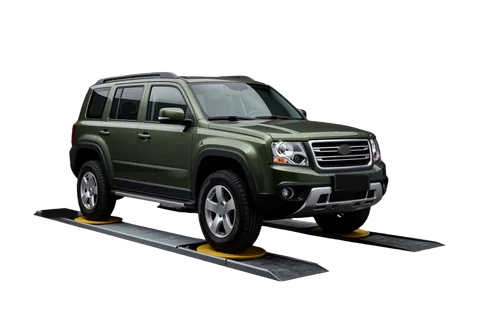
On SUVs and crossovers with independent 4WD suspension, we adjust all four wheels, not just the front axle. All-wheel drive distributes traction to both axles, and rear angles here affect handling no less than front ones: incorrect rear toe causes yaw at speed and uneven tread wear. We lift the car on a hoist, check for play in the control arms and ball joints, then measure the angles on the stand under working load. On all-wheel-drive vehicles, the rear axle also affects handling and tire wear, so "front only" on 4WD leaves half the angles unset. We have 6 hoists and a 3D stand, so an SUV with independent suspension gets a full four-wheel adjustment.
After which suspension repairs alignment is mandatory
We break down three typical repairs that throw off wheel alignment angles and explain why alignment is done right away, not when the car already pulls to the side.
After replacing tie rod ends
Replacing tie rod ends almost always throws off toe, so we do the alignment immediately after the repair, not later. The tie rod end sits on the threads of the steering rack and sets the wheel's position relative to it: screw a new part on a couple of millimeters differently and the wheel already points the wrong way. The steering wheel ends up crooked even with careful work because the worn tie rod end sat at its own angle. On the stand, we first set the steering wheel straight, then use the adjustment sleeves to bring the toe on both sides back to spec. A tie rod end is a wear part with limited life, and you can't put off the measurement: in a couple of weeks of uneven wear, the tire gets eaten along the inner edge. Here, measurement is part of the procedure, not an optional extra.
After replacing shocks and struts
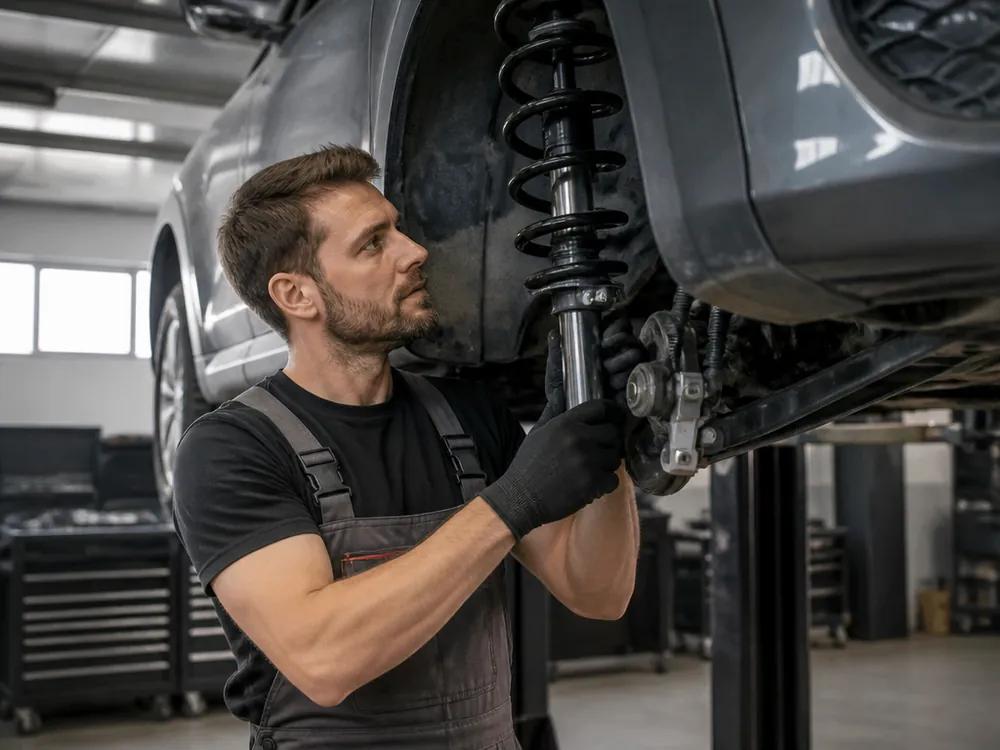
Installing shocks and struts changes the body's position relative to the wheels, so alignment is mandatory. A new strut almost always gives a different ride height: the spring seats differently, the rod extends to a different length, and the control arm sits at a new angle to the body. Angles set for a sagging old shock no longer fit on fresh suspension — camber shifts by a few tenths of a degree, and that's enough to make the car pull. We let the suspension settle right after installation, roll the car, and only then measure on the stand. If one side was replaced, the difference between axles is immediately visible on the printout. If you install struts in pairs, still do the alignment: even identical new parts don't sit exactly like the old ones.
After replacing control arm bushings
Bushings hold the control arm in a set position, so when they are replaced we set the angles anew, not check by eye. A fresh bushing is stiffer than a worn one: old rubber sagged and let the arm wander, while the new one sits in the factory position — the suspension geometry changes relative to what it was before the repair. Alignment brings the angles back to spec, not to the worn state. At CARGID, we only loosen the adjustment bolts and sleeves, we don't heat or bend the arms — we preserve the life of the parts. Measuring on the stand takes less time than replacing tires again, eaten up by misaligned toe. Bushings are replaced in pairs per axle, and after each such job the stand is a mandatory step, not a formality.
Warranty, booking, and what to know before your visit
We explain exactly what we record in the documents after alignment, how to get into the shop without waiting, and what determines whether we finish within an hour.
What the 6-month warranty covers
- Term and documents: we give a 6-month warranty on wheel alignment and record its terms in the work order and the completion certificate when the car is handed over.
- What it covers: the warranty applies to the work performed and the parts installed — if an angle goes off due to our fault, we'll recheck and adjust it again.
- Diagnostics for a warranty case: we do the inspection and measurements free of charge to determine the cause of the discrepancy before any work.
- What voids the warranty: an accident after the repair, third-party interference, natural wear of consumables, and parts supplied by the customer.
How to book and how long to wait without an appointment
We work daily from 09:00 to 20:00, no days off, and with an appointment we take you without a queue. You can book a specific time — then the car goes straight onto the hoist, not into a holding area. If you come spontaneously, you wait as long as the free bay is busy: in the morning hours 09:00–11:00 the queue is shorter than after lunch, when the flow goes to tire service and running gear work. The standard for two axles takes about 60 minutes — that's the time for the measurement and adjustment itself, not counting washing and paperwork. If adjustment bolts or eccentrics need replacement, the work will take longer, and the service advisor will warn you about this before starting, not after the fact. For urgent cases we have a separate option: we take alignment within an hour from the time of booking when the stand and hoist are free. Booking in the morning eliminates almost all waiting — come at opening if your day is tight.
What affects the time and result of the work
- Adjustment bolts: a seized or stripped bolt won't let you set the angle within spec — sometimes it has to be replaced, and it's better to know that before the work starts.
- Corrosion: rust on the threads and sleeves slows down the adjustment, and in bad cases it needs to be treated before measuring.
- Tire pressure: uneven pressure across the wheels skews the measurement, so before the rack we check it and bring it to the manufacturer's spec.
- Loaded axle: we set the angles on the loaded axle without removing the arms — that way the setup matches real driving.
Key Things About Wheel Alignment
Here's the main stuff to keep in mind before and after a wheel alignment — a short list with no repeats and no fluff.
- Pulling and tire wear: the car pulls to one side or the tread wears unevenly — check the angles, but first rule out play in the suspension.
- Three parameters together: camber, toe and caster are set in one go, and the accuracy shows in the printout of the angles before and after.
- Suspension type sets the scope: on a beam axle only the front axle is adjusted, on a multi-link and 4WD — all four wheels.
- Right after a repair: replacing tie rod ends, shocks or bushings changes the geometry, so don't put off the alignment until the first symptoms show up.
- Warranty in the paperwork: the term and conditions are recorded in the work order and the completion report, and it's better to read them before your visit, not after.