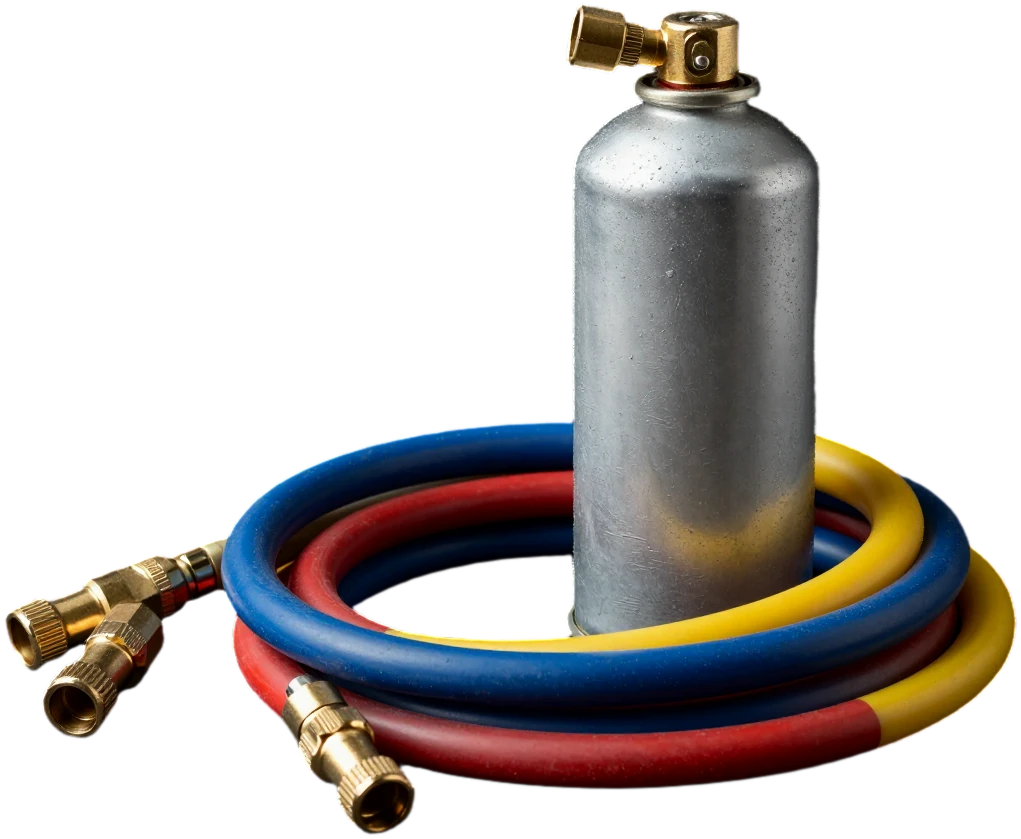












Car air conditioner refill in Almaty by CARGID using the weight method


CARGID refills car air conditioners in Almaty using the weight method: first a computer diagnostic and leak check, then a 30-minute vacuum and a refill with R134a or R1234yf strictly to the manufacturer's spec. The work is covered by a 6-month warranty, and we record the timeframe and terms in the work order.
When a car air conditioner needs a refill and when it needs repair
Warm air from the vents doesn't always mean "the refrigerant needs topping up." Here's how to tell normal operation from a fault, and why a sealed system doesn't lose refrigerant.
Signs it's time for an air conditioner diagnostic
- Weak cooling: the air from the vents is barely cool even at max — the system has lost some of its charge or the pressure in the circuit has dropped.
- Warm air at idle: it blows warm at a stoplight but the cool air comes back at speed — a signal to check the condenser airflow and the fan.
- Oil spots: oil traces on the lines, service ports, or near the compressor show where the refrigerant is leaking.
- Ice on the evaporator: frost or condensation on the evaporator line points to poor circulation and moisture in the circuit.
- Whistling and clicking: unusual noises when the compressor kicks in call for checking the clutch and belt tension.
- Cooling lost in traffic: if it comes back on the highway, it's usually the condenser airflow rather than the refrigerant charge, and a top-up won't help here.
Why a sealed system doesn't use up refrigerant
In a closed circuit the refrigerant circulates without loss, so "topping it up every season" is a myth: if the charge is gone, there's a leak. The working fluid doesn't burn off or evaporate through the walls of the lines — it stays in the system as long as the circuit is intact. O-rings, hoses, and valves harden over time from temperature swings, and that's where the charge escapes through those joints. A micro-leak builds up over months: over a season the charge drops enough that cooling weakens, even though there's no obvious rupture. Almaty's heat and dust speed up wear on the rubber and hoses, so what we see most often isn't "natural consumption" but a micro-leak at the connections — that's what needs to be found, not topped up endlessly. A nitrogen leak test shows whether the circuit is leaking before any refill. Refilling a car air conditioner without that check only hides the leak for a while, so we look for the cause first.
When a refill isn't enough and repair is needed
We sometimes see cooling not come back after service — then the cause is the compressor, expansion valve, pressure sensor, or a blockage, and we tell you straight before any work. The compressor may be putting out weak pressure, the expansion valve may stick open, and a clogged receiver-drier won't let the charge through the circuit. Diagnostics for a warranty case is free with us, and the procedure itself carries a 6-month warranty — we record the timeframe and terms in the work order when you pick up the car. That's why we start with a computer diagnostic of the air conditioning system and a leak check, not with selling refrigerant: that way the customer doesn't pay for work that will just leak out through the same port. A written estimate first, work only after you agree.
How a car air conditioner refill by weight works
Here's what our climate system service involves — from check-in to the final reading — and why the weight method rules out "poured in whatever they felt like."
Steps from check-in to pickup
- Check-in: the service advisor takes the car, inspects the circuit, and records the complaints in the work order.
- Diagnostics: a computer check of the air conditioning system and an inspection of the ports show whether the circuit is sealed.
- Vacuum: we hold vacuum for 30 minutes to pull out air and moisture — otherwise cooling weakens.
- Refill by weight: we charge R134a on the station strictly to the manufacturer's spec and by the gauges.
- Final reading: we start the engine and check the pressure and the temperature at the vents.
- Pickup: the service advisor sees the work order through to the end, so the customer can follow each step and doesn't have to chase the tech around the shop.
Why we refill by weight, not by eye
We charge the refrigerant by weight and gauges, then verify it on a running engine — the charge comes out even, with no overfill or underfill. The station weighs the refrigerant to the gram, the gauge manifold shows the pressure in the circuit, and we take the manufacturer's spec from the technical documentation for the specific model. On engines with a small circuit volume, a 50-gram difference is already noticeable in cooling, while on SUVs and minivans the spec reaches 900 grams and up — that's where "by eye" misses most often. Overfilling puts extra load on the compressor and gives weak cooling, underfilling gives the same warm air, so both are equally bad. A car air conditioner refill by weight in Almaty takes a predictable amount of time and gives consistent results regardless of the weather outside. Before your visit, ask whether the shop weighs the refrigerant or fills by gauges — the second option gives different results on the same car in winter and in the heat.
How long it takes and whether you need an appointment
- With an appointment: we take you without a wait, and the service advisor has the car ready for the scheduled time.
- Without an appointment: there can be a line in the heat, and we'll give you an exact time after diagnostics, not blindly.
- Hours: daily from 09:00 to 20:00, seven days a week — you can come after your shift.
- What to bring: your car documents and the work order if it's a repeat visit.
- Warranty timing: diagnostics for a warranty case is free, and we write the timeframe and terms in the report.
Leak check and leak detection before a car air conditioner refill
Topping up the refrigerant and finding the cause of its loss are different jobs. Here's when a refill is enough and when, without a leak check, the new charge will be gone within a week.
A simple refill or a refill with leak detection
| Situation | What we do | Why |
|---|---|---|
| Cooling lost for the first time, pressure holds | Refill by weight | Restore the refrigerant charge |
| Refrigerant has leaked before | Nitrogen leak test | Find the leak before refilling |
| Oil spots on the lines | Leak detection and resealing | Fix the cause, not the symptom |
| Warm again after a refill | Warranty diagnostic | Tell a new leak from a poor job |
Why nitrogen and dye are needed
We use nitrogen to raise the pressure in the circuit and find leaks where they aren't visible, and the dye helps track micro-losses by the trace at the joints. We pump gas into the circuit at a pressure above the working pressure — this reveals cracks in the tubes, loose connections, and leaking seals that don't leave a visible trace during normal operation. We add UV dye together with the oil: it settles at the leak point and glows under the lamp on the ports, radiator, and expansion valve. The dye doesn't fix the system — it's a marker: if a trace shows up a month later, we know exactly where to look and don't have to guess. In my opinion, this pair gives more than a repeat top-up without disassembly.
Why we replace valves during service
Old Schrader valves often leak at the threads, so we replace them right away — after that the port doesn't seep and the charge holds. Over time, the valve seat on the port gets worn, and refrigerant escapes in a thin stream even when the valve is closed. Before service, we pressure-test the circuit and check whether the port holds pressure after removing the hose. We install new valves on both ports at once so we don't have to revisit this unit during the next visit. A can from the store doesn't solve this problem: it adds refrigerant through the same leaking valve, and in a couple of weeks the cold is gone again. That's why we check the valve seat right away and replace it if worn — this way the charge holds all season, not just until the first heat.
Refrigerant types and what we fill when recharging a car air conditioner
We explain how R134a differs from R1234yf, why they can't be mixed, and what determines the refrigerant volume on different cars — from a sedan to a minivan with a rear evaporator.
How R1234yf differs from R134a
- Different circuits: these two compounds are designed for incompatible systems, and mixing them leads to loss of cooling and risk to the compressor.
- Different operating range: the modern compound has a different pressure, and in a circuit designed for the old one it won't reach the required mode.
- Its own oil: each compound requires a specific lubricant; when mixed, it loses its properties.
- Consequences of a mistake: performance drops, the compressor runs overloaded, and the system wears out faster.
- Who sets the type: the car manufacturer, not the service, so we verify the compound by make and model rather than pouring whatever is at hand.
Refrigerant top-up for a specific car
We top up the car air conditioner with refrigerant strictly according to the manufacturer's specification, so SUVs and minivans take more than passenger cars, and that's not paying extra for air. We take the specification from data for the specific model, not an average value: cars with two circuits or a rear evaporator have a noticeably higher figure than a sedan with one evaporator. Before filling, the service advisor checks the make, model, and refrigerant type, and after the procedure takes a control measurement with the engine running. Underfilling or overfilling equally disrupts system operation, so a guess isn't good enough — you need exactly the weight specified for your model. It's worth checking the specification in the manual beforehand: that makes it easier to understand why your car's figure differs from a neighbor's compact. Recharging by weight takes little time but eliminates volume errors.
What refrigerants we work with
| Refrigerant | For which cars | Filling specifics |
|---|---|---|
| R134a | Most cars | Base option, filled by weight |
| R1234yf | Modern cars | Separate circuit, not mixed with R134a |
| With oil and dye | When a leak is suspected | Dye as a marker for micro-losses |
Warranty on car air conditioner recharge and what to do if it's warm again
We explain what exactly the recharge warranty covers, how warranty diagnostics work, and why customer-supplied materials change the terms. These are the questions most often asked after the car is returned.
What the 6-month warranty covers
- Term: we provide a 6-month warranty on the recharge and record it in the work order and the completion certificate when the car is returned.
- Scope: the warranty covers the work performed and the parts we install — valves, O-rings, hoses, sensor.
- Exclusions: accidents after repair, third-party intervention in the system, natural wear of consumables, and parts supplied by the customer.
- Warranty diagnostics: if cooling is lost within the term, we check the system free of charge, with no separate fee for finding the cause.
- Documents in hand: the term and conditions are written in two documents, so in a disputed situation you don't have to recall verbal agreements.
If it's warm again after service
If cooling is lost during the warranty period, we perform diagnostics as a warranty case free of charge and look for a hidden leak rather than just topping up refrigerant again. The technician checks the circuit with nitrogen, inspects connections, ports, and lines under pressure, and examines the condition of the compressor and pressure sensor. A hidden leak often shows up only on a warm engine or at higher RPMs, so we check not once but in operating modes. Repeated loss of cooling more often indicates an unresolved leak than bad refrigerant — that's why the second time we start from finding the cause, not from a refrigerant can. In my opinion, this approach is what distinguishes proper work from a quick five-minute top-up.
Customer-supplied refrigerant and oil
- You can bring: we accept your refrigerant and oil if the material matches the specific car's system by type and specification.
- Warranty boundary: the warranty does not cover the customer's material itself — we are responsible for the quality of the work performed, not for the contents of someone else's can.
- Why: we don't know the storage conditions or origin of the refrigerant, and a counterfeit or moisture-contaminated can kills cooling faster than any leak.
- Transparency: we show and return old parts to the customer so it's clear what was replaced — the same principle applies to materials.
- Advice: if you're unsure about the origin of the can, get the refrigerant from us — then the warranty covers both work and material.
Booking, timelines, and how to get car air conditioner recharge service
There are two ways to get service: come to Mukagali Makataeva or request a mobile visit. Below is how to arrange a time, what to bring, and what determines the final scope of work.
How to book and what to bring
You can book ahead — with an appointment we take you with no line, we work daily from 09:00 to 20:00, seven days a week, and the shop is at 129 Mukagali Makataev St., Almaty. Your car is met by the service advisor, who also handles the work order through to handover. Over 12 years more than 9,000 cars have come through the bay, so check-in takes just a few minutes: we looked it over, matched the model, and did the paperwork. All you need to bring is the car's documents — we determine the refrigerant type and capacity from the model and the manufacturer's tables, not from what the owner says. Come at your scheduled time: the lift and the technician are already free for your car, and waiting in the bay won't eat up your day.
Mobile and urgent refill
We do mobile refills on site and urgent ones the same day — you pick the format if it's inconvenient to bring the car to us. Mobile service helps when the car isn't driveable, is parked in an underground garage, or the owner is too busy to carve two hours out of the schedule. On a mobile call we refill by weight and pull a vacuum, so the dose stays exact, not approximate. What can't be done on site: replacing the receiver-drier or expansion valve requires a lift and taking the circuit apart, so we honestly move those cases to the shop. The urgent format is for those who caught a warm draft from the vents in the morning and want to drive with cold air by evening; the technician will fit you into a window in the schedule. In my view, mobile service makes sense as a quick fix, not as a replacement for a full diagnosis.
What the scope of work depends on
- Refrigerant type: R134a and R1234yf are serviced with different equipment, and the set of operations differs.
- System capacity: a sedan, a Jeep, and a minivan need different amounts of refrigerant and vacuum time.
- Valve condition: old Schrader valves leak at the threads, and we replace them during service.
- Leak detection: if the system is empty, we first check tightness with nitrogen.
- Worn components: the receiver-drier, expansion valve, and pressure sensor are replaced as separate items.
- Service format: mobile call, urgency, and topping up oil with dye all affect the total.
- Estimate before work: diagnosis and a written estimate first, work only after the client agrees.
Car AC refill key points
The five points below cover the main questions about air conditioner service: where the refrigerant goes, why scales matter, and how to judge a shop's terms before your visit.
- A sealed system doesn't use up refrigerant: if the cold is gone, look for a leak, not a top-up — otherwise the refrigerant will escape again through the same micro-crack.
- Dosing by weight and gauges: an even charge instead of "by eye," where overfilling and underfilling both harm the compressor and cooling equally.
- Nitrogen and dye: they find a micro-loss in one visit instead of masking it with a fresh charge for a month.
- R134a and R1234yf are incompatible: the carmaker determines the refrigerant type, and you can't just pour in whatever's on hand.
- Warranty and transparent terms on customer-supplied materials: they remove the main fear — "I paid, and a month later it's warm again."